
Today was Friday, May 16, 2014. We would be walking most of the day and were instructed that we must stick close together. It would be very easy to lose someone and very difficult to find that person!

We entered the Old City at the Lion Gate. The walls were built during the Ottoman period by Sulliman the Magnificent. He had a dream that he was attacked by lions, so he built the walls with lions on them.


We first went to St. Anne's Cathedral. It is said to be the home of the mother of Mary and the traditional site of Mary's birthplace. It was a beautiful, peaceful place. It is built over a cave – where they found graffiti that they think identifies the place as the home of Anne and Joachim (Mary’s parents).


It is the best preserved Crusader
church. The Muslims controlled the
church for a long time then finally turned it over to the white-frocked
Franciscans.
 The grounds outside were absolutely gorgeous!

The grounds outside were absolutely gorgeous! 

Tarek
told us this was the "Singing Church" because all the groups that go
inside sing there. After a wonderful Asian group sang a beautiful song
with four part harmony, our group got up and sang "The Spirit of God." I
can assure you we didn't sound like the Mormon Tabernacle Choir! But
we sang with our hearts and the Asian group clapped for us. They were
being very kind!


Pool of Bethesda – at the bottom of the ruins outside the church is
the famous Pool of Bethesda, where Jesus healed (on the Sabbath) the man who
had been an invalid for 38 years, and because he was bedridden, he could not make his own way into the pool which was believed to have healing powers. (John 5:1-18) The Jews sought to slay Jesus because he had done this on the Sabbath Day.

During
the Byzantine and Crusader periods, churches had been built over the
pools. Now there are only ruins.


Originally there were 5 porches surrounding the pool.


It was also referred to as “the pool of shame” because of the people who gathered there to be healed.


We then started our way down the Via Dolorosa or “The Way of the Cross.”
 The Via Dolorosa is 14 stations of the cross to commemorate the journey of Christ from
his trial to his death. We walked along and Tareq pointed out each
station.
The Via Dolorosa is 14 stations of the cross to commemorate the journey of Christ from
his trial to his death. We walked along and Tareq pointed out each
station. 
 Two benefactors from America paid to have this wall with pictures of each of the 14 stations put up--then markers were installed along the street to help you understand the traditional locations for what happened at each point along the path Jesus followed carrying the cross.
Stations of the Cross
1. Jesus is condemned to death by Pilate in the Antonia Fortress

2. Jesus carries his cross while wearing a crown of thorns and a robe--after being scourged.


According to tradition, this is the site Pilate presented Jesus who had been scourged, bound, and crowned with thorns to a hostile crowd shortly before his Crucifixion. (John 19 5): "Then came Jesus forth, wearing the crown of thorns, and the purple robe. And Pilate saith unto them, Behold the man!".


The Church of Flagellation as seen above is on the east side of the courtyard.


The Via Dolorosa procession takes place every Friday at 3pm, starting from Station 1, and is led by the Franciscans.

I don't know how to take this--making money off of something so severe that happened to Jesus. But looking at it reminded me of the cruelty and mocking spirit of those who made this in Christ's day and crowned him, "King of the Jews."
3. Jesus falls for the first time.
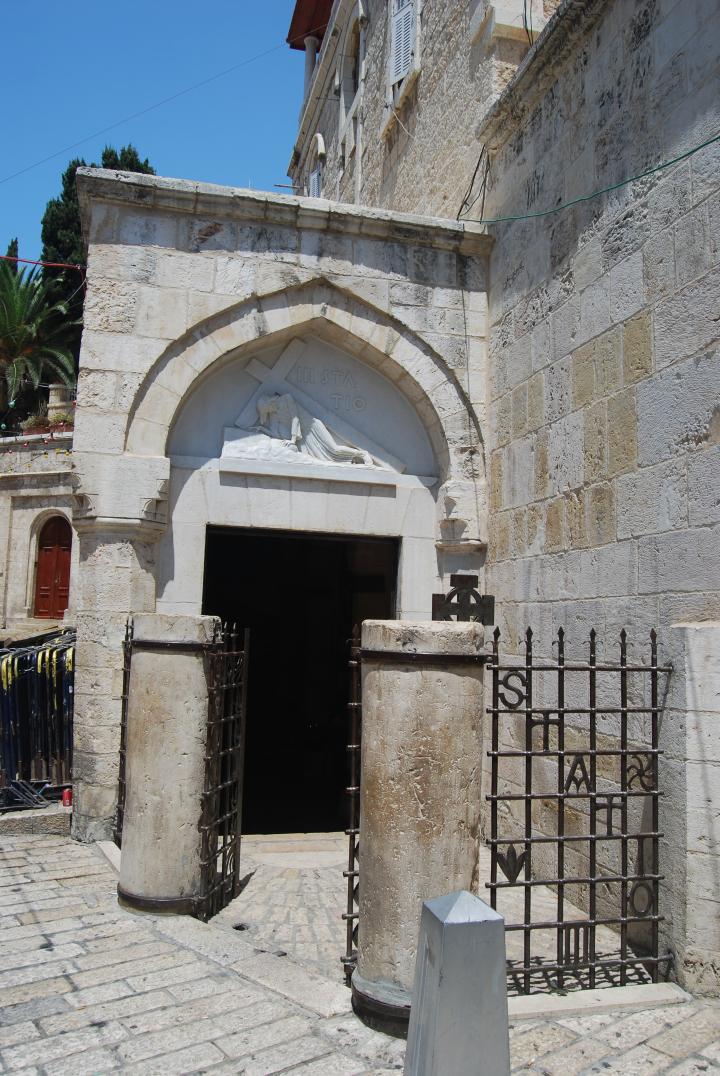 At this site is this
small chapel built during the 15th century by the Armenian Catholic
church. In 1947-48 it was renovated with the financial assistance of the
Polish army.
At this site is this
small chapel built during the 15th century by the Armenian Catholic
church. In 1947-48 it was renovated with the financial assistance of the
Polish army. 
4. Jesus meets his mother Mary (no one from home town is supposed to be there for crucifixions.)

An Armenian church is located behind the walls of this site. As per John 19:26: "When Jesus therefore saw his mother, and the disciple standing by, whom he loved, he saith unto his mother, Woman, behold thy son!"
5. Simon of Cyrene (Libya) helps Jesus carry the cross. (Simon was there for the Passover.)


A small Franciscan church is located at this station, dedicated to Simon the Cyrenian, who assisted Jesus with the cross. This is based on Luke 23:26: "And as they led him away, they laid hold upon one Simon, a Cyrenian, coming out of the country, and on him they laid the cross, that he might bear it after Jesus".
 An old
square stone,
located on the right side of the structure, has a cavity which is said to be the
imprint of Jesus' hand.
An old
square stone,
located on the right side of the structure, has a cavity which is said to be the
imprint of Jesus' hand.

7. Jesus falls the second time while exiting the city gate.

Behind the doors is a small chapel, with stairs leading to the second level (which is closed to the public). The Franciscans took possession of the chapel in 1875. The framed picture inside shows the scene of Jesus falling under the weight of the cross.
8. Jesus meets the crying women ("daughters") of Jerusalem and told them to cry for themselves not for him.
9. Jesus falls the third time.


A Coptic Orthodox Monastery is located very near to this place.


We were able to go inside the church.


The next four stations are supposedly inside the Church of the Holy Sepulcher. It was very crowded inside as six different churches are part of this site: Coptic (Egyptian, Ethiopian Orthodox, Greek Orthodox, Syrian Orthodox, Armenian Orthodox, and Roman Catholic.) Constantine’s mother said this was the site so a church was built here during the Crusader Period.

Outside courtyard of the Church of the Holy Sepulcher. A mosque is visible
very nearby – slightly higher than the church (on purpose). Some housing is also visible.
We had to wait a short time in the courtyard until we could go inside because the building was already pretty packed!


Tareq told us that because 6 different faiths have this church together,
there were disputes over who would hold the keys. By law, a man sits just outside the door. He is the keeper of the key during the
day. At night the police keep the key. As part of the status quo ruling, generations ago two Muslim families were
given the assignment to keep the key. This duty has been passed down from
father to son for many generations and still they do this task today.
10. Jesus is stripped of his garments (entrance to Calvary)

-->
Courtyard of the Church of the Holy Sepulchre -
Notice the ladder on the second
story. This “immoveable ladder” has been
there since 1853 due to the status quo law. It cannot be removed unless all the church's together decide to do so.

11. Crucifixion: Jesus is nailed to the cross (Roman Catholic side altar)


12. Jesus dies on the cross (main Greek Orthodox altar)

Jesus is crucified and dies on the cross, ending His agony.

The
location of this station, 12, is a Greek Orthodox crucifixion altar
which is inside the Church of Holy Sepulcher. A silver disk with a
central hole, underneath the altar, marks the spot where the Cross
stood, and pilgrims kneel and kiss the spot, as seen below.

Here you can see the people lined up to go underneath the altar to touch or kiss the spot which supposedly marks the spot where the Cross stood.

The silver icons of the Virgin Mary and St John are on Jesus' side.

The silver icons of the Virgin Mary and St John are on Jesus' side.
13. Jesus is taken down from the cross and his body is prepared for burial (to the left of the main altar and marked by the statue of Mary)


There is a large mosaic on the wall depicting the last
three stations of the cross.


I have to say that it isn't easy feeling calm and reverent in a place where so much is going on. It was interesting to see the places that many since the 4th Century regard as the points where Jesus was in his last hours. However, others regard the alternative Garden Tomb elsewhere in Jerusalem, as the true place of Jesus' crucifixion and resurrection. We would be visiting that the next day, and I will say, I felt so much more calm and peace there, that I felt it to be the true place for these events.
Interesting Places and Facts we Learned in the Old City Jerusalem.

We saw doors leading to homes in the old city as is shown below. Many Israeli settlers are paying very high prices to buy the homes of Muslims in the Old City (but they need bodyguards to stay there).


So many more interesting places off the beaten path that you just wish you could see, too.


Women selling grape leaves right on the streets.

Bread items are sold right out in the open air.
The Old City is a world heritage site so no remodeling can be done. We saw an old sarcophagus with a water spout above it. This was a way of providing water for animals.


Arriving at The Western Wall. We finally got to go and touch the Western Wall. We were all looking forward to doing this. We had to go through security before entering this area.
Jews believe that the divine presence never leaves this wall. Jews believe there are over 600 orders from God (the same as the number of seeds in a pomegranate!)– but they only do 300 now because there is no temple.

Why ritual bowing while praying? They are imitating the bowing of the High Priest in the presence of God. In ancient times the High Priest (the only one who could enter) was tied with a rope and bells before entering the holy of holies – in case he died while in there. He could then be pulled out by the rope so no one would have to enter the sacred holy of holies. He would bow up and down so those outside would know he was still alive when they heard the bells tied around him ringing.

With the Pope coming the next week, they were really beefing up the security in the area.

There are “washing stations” around the plaza. These are fountains where people ritually wash their hands before praying at the wall.
Jews believe that the divine presence never leaves this wall. Jews believe there are over 600 orders from God (the same as the number of seeds in a pomegranate!)– but they only do 300 now because there is no temple.
Why ritual bowing while praying? They are imitating the bowing of the High Priest in the presence of God. In ancient times the High Priest (the only one who could enter) was tied with a rope and bells before entering the holy of holies – in case he died while in there. He could then be pulled out by the rope so no one would have to enter the sacred holy of holies. He would bow up and down so those outside would know he was still alive when they heard the bells tied around him ringing.
With the Pope coming the next week, they were really beefing up the security in the area.
There are “washing stations” around the plaza. These are fountains where people ritually wash their hands before praying at the wall.

The men and women worship
separately. Many read out of prayer books or scriptures while
at the wall. Most are orthodox Jews
(evident by their clothing). This is the most sacred site in Judaism. When the Romans destroyed the second Temple in the year 70 CE and razed the city (and much of the country), one of the few things to remain was the Western Wall in Jerusalem. This is the closest thing they have to a
temple.

There is a custom to write down your prayer on a scrap of paper, fold it
up as tiny as possible, and slip it between the cracks in the wall.
Every so often the Rabbis in charge of the Wall collect the prayers to
make room for more, and bury them.

Men and women are divided at the wall. This is the men's side.

Men are
required to have their heads covered.

 It appeared that stands were available for those wanting something to hold their scriptures or prayer books.
This is the women's side. We spent about 20+ minutes and
were able to go to the wall and leave a prayer if we so desired.

This is at the very end of the women's side of the WesternWall.

This is at the very end of the women's side of the WesternWall.

For thousands of years, people have come to pour out their hearts and
their tears at this wall. This is why you’ll often hear it called the
"Wailing Wall" in Jerusalem.


Women had the option of covering their heads or not.
 It is considered a sign of disrespect to turn your back on the wall. This explains why you'll see people backing away from the wall (occasionally looking over their shoulder to avoid bumping into someone), until they are about half-way up the plaza.

After we had gone up to the wall, we had time to just observe all that was going on.
It is considered a sign of disrespect to turn your back on the wall. This explains why you'll see people backing away from the wall (occasionally looking over their shoulder to avoid bumping into someone), until they are about half-way up the plaza. After we had gone up to the wall, we had time to just observe all that was going on.

Watching the many different people coming to the Western Wall was very fascinating.


A kitchen for feeding the needy faces the Western Wall.

Again, we saw a bomb depository. In such a close quarter, if a bomb were found, there would be no way of getting it out of the city on time, so they have these depositories that have a tunnel deep in the earth, so the bomb would detonate far below the surface, thus cutting down on the impact. Such a sad way of life we have to live now worrying about evil people bombing areas where many people are.

After visiting the Western Wall, we walked through the Christian Quarter and ate lunch in a little outside-cafe in Old City Jerusalem.
After visiting the Western Wall, we walked through the Christian Quarter and ate lunch in a little outside-cafe in Old City Jerusalem.


We were all so thrilled to have some good ole' American food--pizza and Diet Cokes! The best!

After a delicious lunch, we continued on with our tour of Old City Jerusalem.


1 comment:
Incredible!!! That's the word that keeps coming to mind as I read through your recap. I was there and yet I learned so much from this blog post alone. Thank you for devoting all of this time and effort. It is appreciated.
Post a Comment